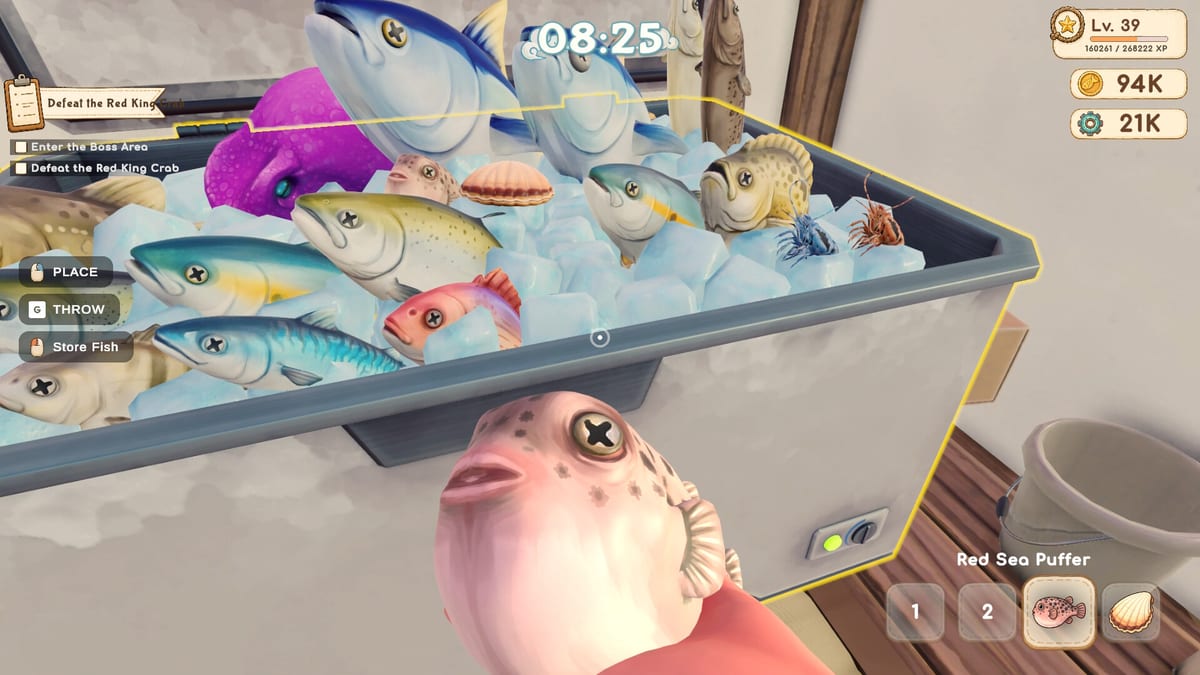
Deep Blue Sushi Multiplayer Roles
Five jobs in a five-player sushi kitchen.
When you start a co-op session of Deep Blue Sushi, the lobby does not enforce a class system — every player has the same toolset and the same body. What changes the game is who you assign to what station, and which chat messages you establish before the dinner rush starts. The roles below are the working arrangement for a 5-player service. They scale down cleanly to 4, 3, and 2 players, and to 1 player solo. Every role description includes a default equipped tool, a default home station, and the call-outs you should rehearse before service begins.
Why Roles Matter
Two kitchens, identical restaurant level, identical upgrades — one earns $4800 per service and one earns $3700. The difference is almost always role discipline. Players who own a station, communicate every state change (“service started”, “oxygen at 30%”, “Golden Tuna on the dock”), and never break to chase a different job run the smoother service. Roles are not a class system; they are an agreement.
The Five Roles At A Glance
| Role | Default Tool | Home Station | Eats Risk Of |
|---|---|---|---|
| Diver (×2) | Harpoon + Oxygen Tank | Dive Dock | Creatures, oxygen, lost catch |
| Sous Chef (×1) | Chef Knife + Cutting Board | Prep Counter | Timing slip → waste of fish |
| Head Chef (×1) | Pass / Plate-Up Bell | ChefDesk | Order queue, plate offsets |
| Server (×1) | Plate Tray | Restaurant Floor | Customer patience drop |
| Manager / Floater (×0 or ×1) | Pen + Recipe Book | Floor / Anywhere | Late callouts, handoffs |
This composition holds up for the current v0.1.5-ea.8 build. Earlier launch-week builds (pre-Aug 22) had chefdesk double-trigger bugs that the new Player Collision toggle and the Hitbox normalisation pass made much less punishing, so two-chef compositions are now viable again.
Diver
Divers feed the kitchen. Everything else on this list exists because the divers decided what fish they were hunting.
Job Description
- Enter the ocean from the Dive Dock as soon as the service window opens.
- Prioritise high-value fish on the Fish Tier List — Golden Tuna, Deep Sea Bass, Moonfish.
- Surface for oxygen at 30%, not at 5%. The 30% rule is the cheapest way to avoid lost catches.
- Deposit fish at the ChefDock on the way back up so the Head Chef sees them.
Default Loadout
- Basic or upgraded Harpoon — exactly the tier of the current zone. A Deep Sea Harpoon is overkill in the shallows but a liability underwater (longer wind-up).
- Highest oxygen tank you can afford — never leave the dock with the starter tank after Day 1.
- Diving Fins — sprint outruns predators, full stop.
Verbal Callouts
- “Dock” — at the surface, fish ready to hand off
- “O2 low” — under 30%
- “Shark” — predator sighted, indicate direction
- “Need X” — call out an ingredient the Head Chef flagged
When The Diver Should Switch Out
If a Diver has spent their full oxygen tank twice in one service, swap. A tired diver is a slow diver, and a slow diver is a dead diver in the deep.
Sous Chef
The Sous Chef owns the cutting and prep work. Without a strong Sous Chef the kitchen bottlenecks at the cutting board within minutes of opening.
Job Description
- Clears the cutting board of fish delivered by divers.
- Slices them into portions sized for the current recipe.
- Keeps the rice cookers refilled and the prep bowls organised by recipe type.
- Hands portions to the Head Chef at the ChefDesk.
Default Loadout
- Chef Knife — cutting work
- Cutting Board — reserved station
- Bowl caddy — to keep rice, nori, sauces separated
Timing Notes
- Timing windows on Sous Chef slicing (cut portions, julienne) are wider than the Head Chef’s plating windows; this is intentional and how the game lets a slower player still be useful at the cutting board.
- If the Head Chef is overloaded, the Sous Chef plates a short-order recipe (any Mackerel variant) to relieve pressure.
Verbal Callouts
- “Portions up” — ready for the Head Chef
- “Rice low” — needs the cook to dump more rice
- “Pass me X” — asks the diver to prioritise an ingredient
Head Chef
The Head Chef runs the ChefDesk. After v0.1.5-ea.8, the desk interactions are stable; before that patch, this was the most punishing role in the game.
Job Description
- Pulls orders from the order queue one at a time.
- Sources the right portion from the Sous Chef’s stations.
- Executes the timing-window steps on the ChefDesk: pressing the interaction key when the timing marker is in the good zone.
- Plates the dish and either hands it directly to the Server or places it on the pass.
Default Loadout
- Chef Knife (pairing) — for fine cuts needed mid-plate
- The Pass Bell — visual and audio cue for the Server when a plate is ready
- Plating tray — used for toppings
Timing Notes
- The ChefDesk timing window is the tightest in the game. Mashing the interact key is the most common mistake — it produces a failed dish and sometimes a phantom plate.
- The Plate-Up Feedback introduced in v0.1.5-ea.8 makes hand-off to the Server much easier: a green glow stays on a finished dish until the Server picks it up.
- If a step fails, drop the ingredients in the trash bin immediately so the next order can start clean.
Verbal Callouts
- “Service” — service is open
- “Up” — current plate is ready
- “Failed” — current dish failed; reset the desk
- “Switch” — request the Sous Chef take the desk while you cool down for a moment
Server
The Server carries finished plates to tables and clears trash. They live on the floor.
Job Description
- Watch the pass for finished plates.
- Carry two plates at a time to maximise floor coverage.
- Land plates on tables facing the customer.
- Pull empty plates back when customers finish and dump them in the trash bin near the side station.
Default Loadout
- Plate Tray — holds up to three plates; the “one extra plate” trick is the difference between a clean table rotation and a stuck queue.
Verbal Callouts
- “Up” — picked up a finished plate
- “Cleared X-2” — table X-2 is empty
- “Customer left” — payment collected, no tip (the Head Chef should mark the recipe as low-priority)
Common Mistake
The Server who carries one plate at a time. The Server who clears empty plates only on the way back. Both add a visible 10–15% to overall service time over a five-player session.
Manager / Floater
The Manager role is optional and is the right call when your fifth player wants to contribute without breaking a rhythm they already have.
Job Description
- Tracks the order queue and the ingredient pipeline.
- Refills rice cookers, mops the floor when spills slow the server, and bins trash.
- Makes sure the order ticket is not bleeding into the queue duplicate items.
- Acts as the loudest voice on call-outs.
When To Drop The Manager Role
If two players are struggling in their primary roles, the Manager splits into one of those roles. The Manager exists to absorb 5-player excess; once you have a four-person team, drop it.
Team Compositions By Player Count
1 Player (Solo)
All five roles collapse into one. The loop is: dive → dock → cut → plate → serve. Use the Solo Play walkthrough; the most important trick is to pre-prepare rice and nori before the rush so the prep step on every dish is one tap.
2 Players
- Diver + Chef/Server. Player 1 owns the ocean, Player 2 owns the entire restaurant above water.
- Player 2 swaps between Head Chef and Server depending on whether the order queue or the floor is the bottleneck.
3 Players
- Diver (1) + Head Chef (1) + Server (1).
- Skip the Sous Chef entirely; the Head Chef cuts and plates.
- Use the Co-op Tips page for the standard trios build.
4 Players
- Diver (1) + Diver (2) + Sous Chef (1) + Head Chef/Server split (1).
- The fourth player is the swing role. Whoever the gold-tier ingredients are coming from becomes the second diver; whoever has the rhythm becomes the dedicated Server.
5 Players (Full Crew)
The composition from the table at the top of this page. This is the cleanest, most profitable service rhythm in the game once everyone has run it two or three times.
Pre-Service Briefing (3-Minute Checklist)
Before pressing Start, agree on:
- Who calls out ingredients? (the Head Chef — so divers see one voice)
- Where do fish go? (on the dock rail near the ChefDesk — not the floor, not the counter)
- What happens on a failed dish? (instant reset, then resume queue)
- When does someone switch out? (oxygen spent twice in one service)
- When do we call last call? (Head Chef announces at 5 minutes remaining)
Common Role Mistakes
- Divers staying too deep. If the diver has not surfaced in 4 minutes they have a problem.
- Sous Chef leaving the cutting board. The moment the Sous Chef plates a dish, the cutting board piles up. Cutting board discipline is the entire Sous Chef role.
- Server grabbing plates while the Chef is still plating. The new Plate-Up Feedback cue only glows when the dish is fully plated.
- Manager chasing the kitchen. The Manager’s value is staying out of the way 80% of the time.
Adjusting Roles Mid-Service
Roles are not class-locked. Anyone can grab the harpoon and dive. The trick is to swap at last call, not at the rush peak. Mid-rush swaps lose more time than they save.
Related Content
- Getting Started for the current gameplay loop
- Co-op Tips for team-wide coordination
- Solo Play for when you are running the kitchen alone
- Patch Notes for what v0.1.5-ea.8 changed about the ChefDesk
Frequently Asked Questions
Quick answers to the most common questions.
Are roles enforced by the game?
No. Deep Blue Sushi does not lock classes. Players decide who does what before the service starts and stick to it for the rush. The five-role split on this page is the most reliable 5-player composition but can be adjusted for smaller crews.
Why is the new Player Collision toggle important for roles?
Before the v0.1.5-ea.8 patch, two chefs at the same ChefDesk would step on each other constantly. With Player Collision OFF, late-joiners and the Manager can move through the kitchen faster; ON keeps the chaotic bumping that some players prefer for realism.
When should a diver switch out?
When they have spent their full oxygen tank twice in one service, or when the Head Chef is drowning in Deep Ocean ingredients the underwater team cannot absorb at speed. Switch at last call, never mid-rush.
Does the Manager count toward tips?
Tips are split evenly across the lobby, so an extra Manager is bonus tips per player. The role is usually reserved for 5-player lobbies to keep all four main roles staffed.
How do I avoid the ChefDesk double-trigger bug?
It is fixed in v0.1.5-ea.8. Make sure your lobby is on the current build before assigning the Head Chef role. If you see a staff member unable to interact with the desk, they are usually holding an item they need to drop first.