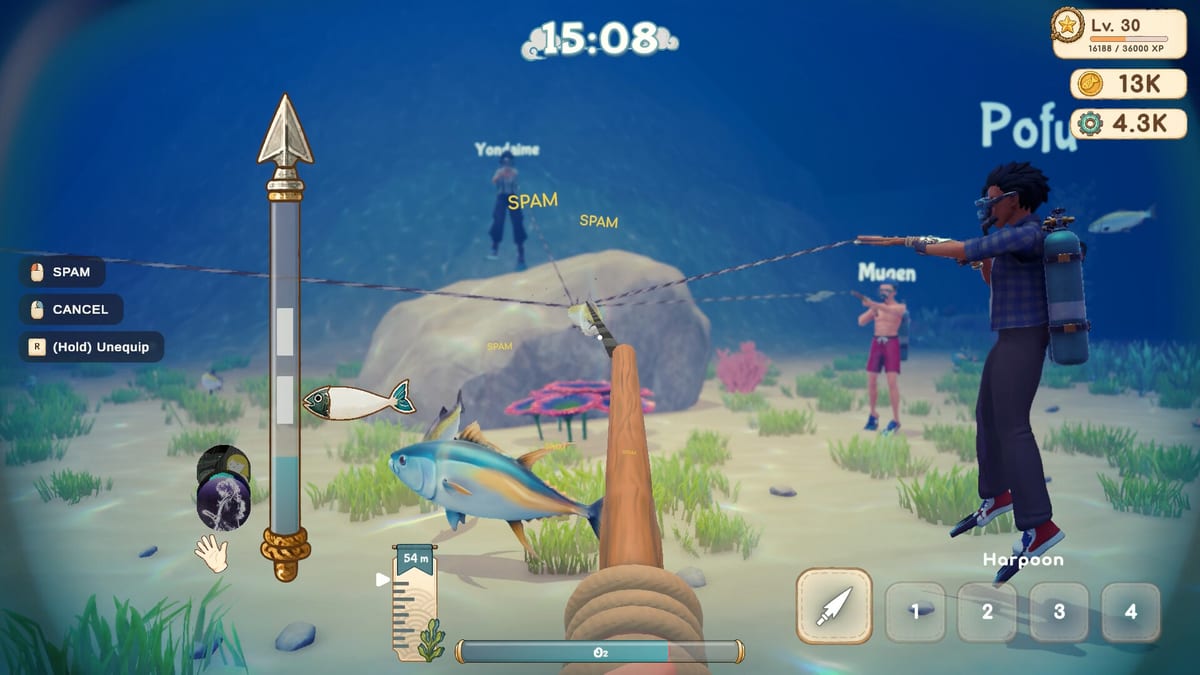
Deep Blue Sushi Co-op Multiplayer Guide
Master teamwork to run the perfect sushi restaurant.
Deep Blue Sushi is designed as a co-op experience for 1 to 5 players. While you can play solo, the game truly shines when you coordinate with friends. This guide covers the best strategies for team play, from duo sessions to full five-player crews.
Role Division
The most effective approach is to assign specific roles to each player:
Divers (2-3 players)
Divers are responsible for exploring the ocean and catching fish. Good divers know the fish locations, manage their oxygen efficiently, and avoid dangerous creatures. In a 5-player team, having 2-3 dedicated divers ensures a steady supply of ingredients. Divers should communicate which zones they are covering to avoid overlap and maximize coverage.
Kitchen Staff (1-2 players)
Kitchen staff handle the sushi preparation and cooking. They need to know all the recipes, manage the timing of each step, and keep up with customer orders during busy service hours. Kitchen staff should pre-prepare common ingredients like rice and nori before the restaurant opens to speed up service during the rush.
Server (1 player)
The server delivers finished dishes to customer tables and handles customer interactions. This role is crucial during peak hours when orders pile up. A dedicated server prevents dishes from sitting on the counter and getting cold, which lowers customer satisfaction.
Communication Strategies
Effective communication is the key to success in co-op:
- Call out fish locations: When you find a valuable fish, tell your teammates so they can prioritize that zone
- Report oxygen levels: Let the team know when you need to surface so someone can cover your area
- Track orders: The kitchen should announce when dishes are ready so the server can pick them up immediately
- Warn about dangers: If you spot a shark or other predator, alert nearby divers right away
- Request ingredients: Kitchen staff should tell divers what fish they need for upcoming orders
- Coordinate dives: Plan dive routes together to cover all needed zones without wasting time
Handling Busy Service Hours
During peak customer hours, the restaurant can become chaotic. Here is how to manage:
- Pre-stock ingredients before the rush begins so the kitchen never runs dry
- Assign one player to handle only serving during peak hours to keep dishes moving
- Prioritize high-value orders when the kitchen is overwhelmed to maximize income
- Communicate constantly about order status and ingredient supply to avoid bottlenecks
- Have a diver on standby to make quick runs for specific ingredients the kitchen needs
Team Sizes and Strategies
Two Players
With two players, one should focus on diving while the other handles cooking and serving. Rotate roles between service cycles to keep things fresh. The diver should pre-stock as many ingredients as possible before the rush.
Three Players
Assign two divers and one kitchen server. The kitchen player handles both cooking and serving. This is a popular team size that balances efficiency with simplicity.
Four Players
Two divers, one cook, and one server. This allows the cook to focus entirely on preparation quality while the server keeps dishes flowing to customers without delay.
Five Players
Two to three divers, one to two cooks, and one server. With a full team, you can specialize heavily and cover every zone simultaneously. This is the most efficient configuration for earning money quickly.
Solo vs Co-op Differences
Playing solo is possible but requires you to manage everything yourself. The game scales the customer count and order complexity based on player count. In solo, you will need to alternate between diving and cooking more frequently. Solo play is great for learning the mechanics, but co-op is where the game reaches its full potential.
Advanced Team Strategies
Once your team has the basics down, try these advanced strategies:
- Rotation system: Rotate roles every few service cycles so everyone gets experience in each position
- Specialized dives: Send specific divers to specific zones based on what ingredients the kitchen needs most urgently
- Efficient communication shortcuts: Develop shorthand for common fish, recipes, and dangers to speed up callouts
- Ingredient pipeline: Establish a continuous flow where divers bring fish while cooks prepare them immediately, avoiding inventory pileup
- Emergency protocols: Agree on what to do when a dangerous creature appears or when oxygen runs critically low
Related Guides
- Getting Started for basic gameplay mechanics
- Ocean Exploration for diving strategies and zone information
- Sushi Recipes for kitchen preparation tips
- Dangerous Creatures for threat awareness and combat strategies
Frequently Asked Questions
Quick answers to the most common questions.
How many players can play together?
Deep Blue Sushi supports online co-op for up to 5 players. You can also play with any number between 1 and 5, and the game scales the customer count based on team size.
What is the best team composition?
For a 5-player team, 2-3 divers, 1-2 kitchen staff, and 1 server works well. For smaller teams, adjust based on your strengths. A duo works well with one dedicated diver and one cook/server.
Does the game scale with player count?
Yes, the customer count and order complexity scale based on the number of players. More players means more customers but also more hands to handle the workload. The scaling keeps the challenge balanced.
Can I switch roles during a game?
Yes, players can freely switch between diving, cooking, and serving at any time. There are no locked roles, so you can adapt to the current situation as needed.
How do we handle dangerous creatures in co-op?
In co-op, one player can distract a dangerous creature while others escape or collect fish nearby. Communication is critical: call out threats as soon as you spot them so teammates can react. See the Dangerous Creatures guide for detailed strategies.